Safety Data Sheet (SDS) Compliance Requirements

OSHA requires an emergency telephone number in Section 1 of every SDS, independent of whether you ship the product.

Last updated: Reviewed by Hazmat Line's regulatory team

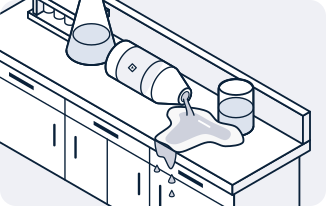
Chemical spill in a workplace lab

Quick answer

Is your company name on a Safety Data Sheet?

Your SDS Section 1 must include an emergency telephone number answered by a person with access to emergency response information for the specific chemical. This obligation comes from 29 CFR 1910.1200 Appendix D: OSHA's Hazard Communication Standard, and it applies to any manufacturer, importer, formulator, or private labeler whose name appears on the SDS, regardless of whether the product is shipped. While the standard does not explicitly mandate 24-hour staffing, OSHA's interpretation letters leave hours of operation to the responsible party's judgment, industry best practice and GHS alignment strongly favor round-the-clock coverage, especially for products with acute health or physical hazards. Most companies satisfy it by contracting with a registered third-party emergency response provider. If you need the number itself, see our SDS emergency phone number service.

Source: 29 CFR 1910.1200 Appendix D, OSHA Hazard Communication Standard (HazCom 2012, updated 2024 / GHS-aligned)

Who Is Required to Have a Safety Data Sheet?

The SDS obligation under 29 CFR 1910.1200 flows through the chemical supply chain. It begins with the manufacturer or importer and must accompany the product through every commercial transaction to the end employer.

  • You must prepare or provide an SDS if…

    • You manufacture a hazardous chemical and sell or distribute it to employers or other downstream users
    • You import a hazardous chemical into the United States for commercial use
    • You formulate or blend a hazardous chemical and your company name appears on the label
    • You are a private labeler, your brand name appears on a product you did not manufacture
    • You distribute hazardous chemicals and no SDS has been provided, you must obtain and pass one through the supply chain
    • You are an employer who uses hazardous chemicals, you must obtain, maintain, and make SDSs accessible to employees during their shift
  • SDS obligations may not apply if…

    • The substance is not classified as a hazardous chemical under OSHA's criteria (29 CFR 1910.1200(d))
    • The product is a consumer product used in the workplace in the same manner and duration as normal consumer use
    • The material is a specific exempt category, food, drugs, or cosmetics regulated by FDA for consumer use
    • The chemical is an article: a manufactured item that does not release hazardous chemicals under normal conditions of use
Lithium batteries are not "articles" under OSHA

Lithium batteries are frequently misclassified as articles and incorrectly excluded from SDS requirements. Under OSHA's definition, an article must not release hazardous materials under normal conditions of use. Lithium batteries do release hazardous materials: electrolyte, toxic gases, and thermal energy, under foreseeable conditions such as damage, short circuit, or overcharge. Manufacturers and importers of lithium batteries are required to prepare and provide a compliant SDS with an emergency phone number in Section 1.

The trigger is your name on the SDS, not whether you ship

The emergency phone number obligation applies regardless of how you ship the product. A company that sells locally, licenses its brand to a contract manufacturer, or ships under the DOT limited quantity exception is still required to provide a compliant SDS with an emergency number in Section 1. The trigger is whether your company name appears on the SDS as the responsible party.

What Is a Safety Data Sheet and Why Does It Exist?

A Safety Data Sheet is the central document in chemical hazard communication. It is not just a regulatory checkbox, it is the source document that feeds multiple downstream obligations and protects everyone who handles, stores, transports, or responds to an incident involving the chemical.

  • What an SDS is

    A standardized 16-section document that describes the hazards of a chemical, safe handling and storage procedures, emergency response guidance, and identification of the responsible party, including the emergency phone number first responders and workers call when something goes wrong.

  • Why it exists

    Hazardous chemicals are handled by workers, transported by carriers, and stored in warehouses by people who did not manufacture them. The SDS ensures that hazard information travels with the product, so a warehouse worker, a truck driver, or a firefighter always has access to the knowledge needed to stay safe.

The 16-section GHS format, Section 1 is where your emergency number lives

OSHA's HazCom standard (2012, updated 2024) aligned with the Globally Harmonized System (GHS). Every SDS must follow the standardized 16-section format in this exact order.

The SDS feeds multiple downstream documents

The SDS is not a standalone document, it is upstream of several other compliance obligations. The proper shipping name and hazard class on your shipping papers must be consistent with the SDS classification. The DOT hazmat label on each package must reflect the hazard class confirmed in the SDS. The employee training required under 49 CFR 172.704 and OSHA 1910.1200(h) is built around the hazard information in the SDS. Getting the SDS right is the foundation everything else rests on.

  1. Identification (emergency number)

  2. Hazard ID

  3. Composition

  4. First Aid

  5. Fire Fighting

  6. Accidental Release

  7. Handling & Storage

  8. Exposure Controls

  9. Physical Properties

  10. Stability & Reactivity

  11. Toxicology

  12. Ecological Info

  13. Disposal

  14. Transport Info

  15. Regulatory Info

  16. Other Info

Section 1, What OSHA requires, from Appendix D

Per 29 CFR 1910.1200 Appendix D, Section 1 must include: (1) product identifier; (2) other means of identification; (3) recommended use and restrictions on use; (4) supplier name, address, and telephone number; and (5) an emergency phone number. The person answering must have access to chemical hazard knowledge, not just a general receptionist. Note: OSHA's interpretation letters (1985, 1986) clarify that the standard does not explicitly mandate 24-hour staffing, hours of operation are left to the responsible party's judgment based on the product's risk profile. However, industry best practice strongly favors 24/7 coverage.

Hazmat Line, a modern emergency response provider built for today's chemical companies

Most emergency response providers assign a shared pool number to dozens of clients. Hazmat Line works differently, each client receives an exclusive emergency phone number, so your SDS always references a line dedicated to your products and your chemical portfolio. There is no risk of confusion with another company's materials during an incident.

Want to know more about how Hazmat Line works?

Talk to our team, we'll walk you through the setup, explain what's included, and answer any compliance questions. No commitment required.

  • What's included in your annual membership

    • Exclusive 24-hour emergency phone number, yours alone
    • OSHA 29 CFR 1910.1200 compliant for your SDS Section 1
    • DOT 49 CFR § 172.604 compliant for your shipping papers
    • Year-round regulatory support, not just a phone number
    • Hazmat-trained specialists available at any hour
    • Transparent annual pricing, no hidden fees, no per-call charges

What Goes Into Creating a Compliant SDS?

Authoring a compliant SDS requires chemical expertise, access to toxicological data, and knowledge of the applicable regulatory framework. It is not a document you can draft from a template without understanding the underlying hazard classification. Below is an overview of what the process involves and the key inputs required.

  • Chemical identity & composition

    The full chemical identity of the product, including trade name, chemical name, CAS numbers, and concentration ranges for each hazardous component. For mixtures, each component above the concentration cutoff thresholds must be identified and individually classified.

  • Hazard classification

    Each hazard category must be determined using OSHA's classification criteria (29 CFR 1910.1200 Appendix A and B), physical hazards (flammability, reactivity, explosivity) and health hazards (toxicity, carcinogenicity, reproductive effects). Classification drives everything else in the SDS.

  • Toxicological & physical data

    Supporting data for each health and physical hazard, including LD50/LC50 values, flash point, boiling point, vapor pressure, and exposure limits (OSHA PELs, ACGIH TLVs). This data must come from reliable scientific sources and must be cited or referenced.

  • Regulatory status

    Section 15 requires identification of applicable regulations, TSCA listings, CERCLA reportable quantities, SARA 311/312 hazard categories, California Proposition 65 listings, and any export control or international regulatory designations relevant to the product.

  • Emergency response information

    First aid measures (Section 4), firefighting measures (Section 5), accidental release procedures (Section 6), and exposure controls (Section 8) must all be specific to the product's actual hazard profile, not generic boilerplate. And Section 1 must include the emergency phone number.

  • Author qualifications

    OSHA does not mandate specific credentials for SDS authors, but the document must be accurate and defensible. In practice, compliant SDSs are typically authored by toxicologists, industrial hygienists, or specialized regulatory consultants with access to chemical databases and classification software.

Minimum required information for each section

Every section of the SDS must contain substantive information, OSHA does not accept "not applicable" or blank fields without justification. Section 3 must list all hazardous ingredients above regulatory thresholds. Section 8 must include specific exposure limits and engineering controls. Section 11 must include all available toxicological data. Section 14 must include UN number, proper shipping name, hazard class, and packing group consistent with the DOT Hazardous Materials Table. A deficient section, even if the emergency number in Section 1 is compliant, can still result in an OSHA violation.

Generic templates and AI-generated SDSs carry real risk

A poorly authored SDS that misclassifies the hazard, omits a component, or copies boilerplate language from an unrelated product can expose your company to both OSHA violations and civil liability if a worker or responder is harmed relying on incorrect information. SDS authoring should be done by qualified professionals working from your actual product formulation data.

Need your SDS authored or reviewed?

Hazmat Line maintains a network of vetted SDS authoring partners, toxicologists, regulatory consultants, and chemical classification specialists who work with companies of all sizes across all hazard classes. Whether you need a single SDS for a new product, a full catalog review, or an update triggered by new hazard information, we can connect you with the right specialist for your situation.

Our partners work with your product formulation data to deliver an OSHA-compliant, GHS-aligned SDS, and we make sure your Hazmat Line emergency phone number is correctly formatted in Section 1 before anything goes out the door.

Tell us about your product and we'll point you in the right direction

No commitment required. We'll recommend the right authoring partner based on your hazard class, product type, and timeline.

Talk to an expert

Need the number itself? From $599/yr, active within 24 hours.

Get started

SDS Compliance Obligations Under 29 CFR 1910.1200

SDS compliance has five distinct obligations. Each applies to a different party in the chemical supply chain, and all must be met for full compliance.

  1. Prepare a compliant SDS, § 1910.1200(g)(1)

    Chemical manufacturers and importers must prepare an SDS for each hazardous chemical they produce or import. The SDS must follow the 16-section GHS format in the correct order and include all required information, including a compliant emergency phone number in Section 1. The SDS must accurately reflect the scientific evidence used in the hazard classification.

  2. Pass the SDS through the supply chain, § 1910.1200(g)(6), (7)

    Distributors must provide the SDS to employers at the time of the first shipment and again whenever the SDS is updated. An SDS must accompany or precede every commercial shipment of a hazardous chemical. Distributors may not withhold SDSs, charge for them, or require a request before providing them with a shipment.

  3. Maintain accessible SDSs in the workplace, § 1910.1200(g)(8), (10)

    Employers must obtain SDSs for every hazardous chemical used in the workplace and ensure they are readily accessible to employees during their work shift, in their work area. Electronic systems are acceptable if a backup procedure exists for power outages. Employees must never be denied access to an SDS.

    • SDSs must be in English, additional languages are permitted
    • Must be accessible without barriers, passwords, or delays
    • Backup access procedure required for electronic systems
  4. Provide a valid emergency phone number in Section 1, Appendix D

    Section 1 of every SDS produced by a manufacturer, importer, formulator, or private labeler must include an emergency telephone number answered by a person with access to hazard information for the specific chemical. The standard does not explicitly mandate 24-hour staffing, but industry best practice and GHS alignment strongly favor it, especially for products with acute hazards. This is the requirement most companies underestimate, and the one Hazmat Line directly addresses.

    • Required on every SDS where your company is the responsible party
    • Industry best practice: 24/7 coverage, OSHA leaves hours to the responsible party's judgment, but round-the-clock is the safer standard
    • Answerer must have access to chemical hazard information for the product
    • A registered third-party emergency response provider satisfies this requirement
  5. Review and update the SDS when new hazard information is obtained, § 1910.1200(g)(5)

    An SDS must be updated within three months of the manufacturer or importer becoming aware of any significant new information about the hazards of the chemical or ways to protect against those hazards. There is no fixed update interval, the obligation is triggered by new information. Updated SDSs must be provided to distributors and employers with their next shipment after the update.

    • Triggered by: new toxicological data, revised classification, new protective measures identified
    • Timeline: updated SDS must be ready within 3 months of obtaining the new information
    • Updated SDS must be passed forward to all downstream recipients

SDS Requirements for Imported and Exported Products

The GHS is a global framework, but each country adopts it independently, at different revision levels and with country-specific additions. A US-compliant SDS is not automatically compliant in another market, and vice versa.

  • Importing a product into the US

    An SDS authored in another country, even one following GHS, may not comply with OSHA's specific HazCom requirements (2012, updated 2024). Section formats, classification criteria, hazard statement codes, and required content can differ. The importer is responsible for ensuring the SDS meets 29 CFR 1910.1200 before distributing the product in the US. This includes ensuring Section 1 contains a US-reachable emergency phone number, not a foreign-country line that may be unreachable in a domestic incident.

  • Exporting a product from the US

    A US-format SDS must be adapted for the destination country's regulatory requirements, including the correct GHS revision they have adopted (many countries are on a different revision than the US), required language, any country-specific regulatory sections, and local classification criteria. Crucially, the emergency phone number in Section 1 must be internationally reachable, with the correct country code, and must be answered in the destination country's language or by someone capable of providing guidance in it.

GHS version mismatches are more common than you think

OSHA's HazCom final rule of May 2024 aligned the US standard with GHS Revision 7 (plus elements of Rev 8). Compliance deadlines, as extended: substances by May 19, 2026 (already in force) and mixtures by November 19, 2027. Other countries sit on different revisions, the EU is on Rev.10, Australia on Rev.7, Japan on Rev.9. This means classification criteria, hazard categories, signal words, and precautionary statements can differ between your US SDS and what the destination country requires. Simply translating a US SDS is not sufficient for export compliance, the document must be reviewed against the destination country's specific GHS adoption and any national deviations.

Your emergency phone number must work across borders

When a US product is shipped internationally, the emergency phone number in Section 1 must be reachable from the destination country. This means including the full international dialing format (e.g. +1 followed by area code for US-based numbers). A domestic US number without a country code will not work for a first responder calling from Europe or Asia. Hazmat Line provides internationally reachable numbers formatted for use on both domestic and export SDSs.

OSHA Penalties for SDS Non-Compliance

OSHA enforces the Hazard Communication Standard through workplace inspections, complaint-driven investigations, and targeted enforcement programs. Penalties are assessed per violation, and each non-compliant SDS, or each employee without proper SDS access, can constitute a separate citation.

  • $165,514

    Max per willful violation

  • Per SDS

    How violations are counted

  • 5 years

    Repeat violation lookback

  • Violation classificationDescriptionPenalty range
    Other-than-seriousMinor technical deficiency, direct relationship to safety but unlikely to cause death or serious physical harmUp to $16,550
    SeriousMissing or non-compliant SDS, missing Section 1 emergency number, employees lacking SDS access during shiftUp to $16,550
    WillfulEmployer knew about the violation and made no reasonable effort to eliminate itUp to $165,514
    RepeatSubstantially similar violation cited within the previous five yearsUp to $165,514
    Failure to abateFailure to correct a previously cited violation within the abatement periodUp to $16,550 per day

The multi-SDS exposure problem

A company with 50 products, each with a non-compliant SDS (missing the emergency number or listing a non-compliant line), faces 50 separate serious violations: potential penalty exposure of up to $827,500 from a single OSHA inspection. Companies previously cited and not corrected face willful or repeat classification, pushing the ceiling to $165,514 per SDS.

Enforcement is complaint-driven as well as inspection-driven

A single employee complaint about inability to access an SDS, or a report that an emergency number was unanswered during an incident, can trigger a targeted inspection of your entire chemical hazard communication program, including every SDS your company produces or maintains. OSHA does not need to observe a violation first-hand; employee testimony and document review are sufficient.

Industries With the Highest SDS Compliance Exposure

The emergency phone number obligation applies across all sectors that produce, import, or use hazardous chemicals. These industries carry the highest combined OSHA and DOT exposure.

  • Chemical manufacturers & formulators

    Every hazardous product triggers both the SDS obligation and, when shipped, the DOT shipping paper obligation. Large portfolios mean large violation exposure. A 200-product catalog with non-compliant SDSs represents millions in potential OSHA penalty exposure.

  • Paints, coatings & adhesives

    Class 3 flammable liquids are among the most frequently shipped hazmat categories. Companies here typically have both OSHA and DOT obligations simultaneously, but frequently address only one or neither.

  • Cosmetics & personal care

    Private labelers and brand owners who do not manufacture their products often overlook the SDS obligation entirely. If your company name is on the label and the product is hazardous, you are the responsible party for the SDS, even if a contract manufacturer made it.

  • Cleaning products & consumer chemicals

    Consumer product exemptions are narrow. A product sold to both consumers and commercial customers cannot claim the consumer exemption for workplace SDS purposes. Mixed-channel companies frequently misapply this exemption.

  • Battery & electronics manufacturers

    Lithium battery manufacturers and importers are required to provide SDSs, batteries are not articles under OSHA because they can release hazardous materials under foreseeable conditions. This category is frequently overlooked and increasingly under enforcement scrutiny.

  • Distributors & wholesalers who relabel

    Pass-through distributors must pass SDSs along, but those who relabel or repackage products become responsible parties, triggering the full SDS authoring obligation including the emergency phone number in Section 1.

Not sure if your SDS Section 1 is compliant?

Our team reviews your SDS emergency number, confirms compliance under 29 CFR 1910.1200, and gets you set up with a dedicated registered number, no commitment required.

Frequently asked questions

Is the SDS emergency number obligation separate from DOT 172.604?

Yes, entirely separate. OSHA's requirement (29 CFR 1910.1200) applies to anyone whose company name appears on an SDS as the responsible party, independent of whether the product is shipped or how it is transported. DOT's requirement (49 CFR § 172.604) applies specifically to shipping papers when hazardous materials are offered for transportation. A company can trigger the OSHA obligation without ever shipping the product. A single registered emergency response provider number can satisfy both simultaneously.

Do lithium batteries require a Safety Data Sheet?

Yes. Lithium batteries are not "articles" under OSHA's definition because they can release hazardous materials, electrolyte, toxic gases, and thermal energy, under foreseeable conditions such as damage, short circuit, or overcharge. Manufacturers and importers of lithium batteries are required to prepare and provide a compliant SDS with an emergency phone number in Section 1. This is a frequently misunderstood area and increasingly under OSHA enforcement scrutiny.

How often does an SDS need to be updated?

Under 29 CFR 1910.1200(g)(5), an SDS must be updated within three months of the manufacturer or importer becoming aware of any significant new information about the hazards of the chemical or ways to protect against those hazards. There is no fixed update schedule, the obligation is triggered by new information, not a calendar. Updated SDSs must be provided to distributors and employers with their next shipment after the update is made.

What are the OSHA penalties for SDS non-compliance?

Serious violations carry penalties up to $16,550 per violation. Willful or repeated violations, where the employer knew about the violation and failed to correct it, or where the same violation was cited within the previous five years, carry penalties up to $165,514 per violation. Each non-compliant SDS can constitute a separate violation. A company with 50 products each missing a compliant Section 1 emergency number could face over $800,000 in penalty exposure from a single inspection.

What happens to an SDS when a product is exported?

A US-format SDS must be adapted for the destination country's regulatory requirements, including their specific GHS revision, required language, and any country-specific classification criteria or regulatory sections. The emergency phone number in Section 1 must also be internationally reachable: it must include the full international dialing format with country code, and ideally be staffed by someone who can provide guidance in the destination country's language. Simply translating a US SDS is not sufficient for export compliance.

If I'm a private labeler, do I need to provide the emergency number?

Yes. If your brand name or company name appears on the product label as the responsible party, even if you did not manufacture the product, you are treated as a manufacturer under 29 CFR 1910.1200 and must prepare or obtain a compliant SDS with a compliant emergency phone number in Section 1. This is one of the most frequently overlooked triggers in the cosmetics, cleaning products, and consumer chemical industries.

What is the difference between an SDS and an MSDS?

An SDS (Safety Data Sheet) is the current term under OSHA's HazCom standard (2012, updated 2024), which aligned with the GHS. An MSDS (Material Safety Data Sheet) was the format under the older HazCom 1994 standard. Both serve the same purpose, but SDSs follow the standardized 16-section GHS format while MSDS formats varied by supplier. OSHA required compliance with the SDS format by June 1, 2015. Any MSDS-format document still in circulation is outdated and non-compliant.

Get your SDS Section 1 fully compliant with OSHA 29 CFR 1910.1200

Hazmat Line provides each client with an exclusive 24-hour emergency phone number, satisfying both your OSHA SDS obligation and your DOT shipping paper obligation, with year-round regulatory support included in your annual membership.