
PHMSA Hazmat Registration Guide

DOT Hazmat Registration: The Annual PHMSA Program Explained

Required to ship certain quantities of hazardous materials? Federal law requires annual registration with PHMSA, a separate obligation from your ongoing 49 CFR Part 172 compliance.
Last updated: Reviewed by Hazmat Line's regulatory team

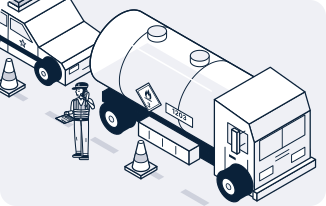
Hazmat tanker truck stopped at a roadside inspection

Quick answer

What Does PHMSA Hazmat Registration Require?

The PHMSA Hazmat Registration Program requires offerors and transporters of certain high-threshold quantities of hazardous materials to file an annual registration statement with the U.S. Department of Transportation and pay a fee under 49 CFR §§ 107.601-107.620.

Important: this registration is separate from, and does not replace, the ongoing 49 CFR Part 172 compliance obligations that apply to every hazmat shipment.

Source: 49 CFR §§ 107.601-107.620, PHMSA 2025-2026 Hazardous Materials Registration Information Brochure

The program

What Is the PHMSA Hazmat Registration Program?

The Hazmat Registration Program has been in operation since 1992. It requires companies that ship or transport hazardous materials above specific quantity thresholds to register annually with PHMSA and pay a fee. The fees fund grants distributed to states, Indian tribes, and nonprofit organizations for hazardous materials emergency response planning and training.

  • What registration does

    Registers your company with PHMSA as an offeror or transporter of significant quantities of hazardous materials. Provides a DOT Certificate and registration number that must be kept on-board vehicles and on file at your principal place of business. Funds emergency response infrastructure across the US.

  • What registration does NOT do

    Registration does not make your individual shipments compliant with 49 CFR Part 172. It does not cover your shipping papers, labels, placards, employee training, or the 24-hour emergency phone number requirement for shipping papers, nor the emergency number your Safety Data Sheets must carry under OSHA HazCom. Those are separate obligations that apply to every hazmat shipment regardless of whether registration is required.

Registration and compliance are not the same thing

Many shippers assume that completing PHMSA registration means their hazmat program is in order. It does not. Registration is an annual fee paid to the federal government. 49 CFR Part 172 compliance, including the 24-hour emergency phone number on every shipping paper, is a separate, ongoing operational requirement that applies to every individual shipment, regardless of whether your company is required to register.

Registration gets you a certificate. Compliance keeps your shipments legal.

Once you’ve completed PHMSA registration, every individual shipment you offer for transport must still comply with 49 CFR Part 172: shipping papers with the correct UN number and hazard class, DOT labels on each package, vehicle placards where required, and a 24-hour emergency phone number on every shipping paper. That last requirement is where most shippers have a gap.

  • PHMSA registration (annual program)

    • Annual fee paid once per registration year
    • Covers your company, not individual shipments
    • Required only above specific quantity thresholds
    • Filed through the PHMSA portal (portal.phmsa.dot.gov)
    • Produces a DOT Certificate and registration number
  • 49 CFR Part 172 compliance (every shipment)

    • Applies to every hazmat shipment, every mode
    • Requires compliant shipping papers, labels, placards
    • Requires a 24-hour monitored emergency phone number
    • Requires trained employees with records on file
    • Violations assessed per shipment by PHMSA and FMCSA

Need the 24-hour emergency phone number for your shipping papers?

Hazmat Line provides a registered 24-hour emergency response phone service that satisfies 49 CFR § 172.604, with immediate setup and transparent annual pricing.

View Pricing

Applicability

Who Must Register?

Registration is required for offerors and transporters of hazardous materials who meet any of the six threshold categories below. These thresholds were established by law (Categories A-E) starting in 1992, with Category F added in 2000.

  • A. Highway route-controlled quantities of Class 7 (radioactive) material

    As defined in 49 CFR § 173.403. A highway route-controlled quantity may be shipped by highway, rail, air, or water. The mode does not change the registration requirement.

  • B. More than 25 kg (55 lbs) of Division 1.1, 1.2, or 1.3 explosives

    Per 49 CFR § 173.50, in a motor vehicle, rail car, or freight container.

  • C. More than 1 liter per package of a material poisonous by inhalation (Hazard Zone A)

    Materials meeting the criteria for Hazard Zone A as specified in § 173.116(a) for gases or § 173.133(a) for liquids.

  • D. Hazardous material in bulk packaging with capacity ≥ 3,500 gallons (liquids/gases) or ≥ 468 cubic feet (solids)

    Note: registration is required even if placards are not. For example, a Class 9 material in bulk packaging above these thresholds requires registration.

  • E. Shipment of 5,000 lbs gross weight or more of one hazmat class requiring placarding

    In other than bulk packaging, where placarding of a vehicle, rail car, or freight container is required for that class under 49 CFR Part 172 Subpart F.

  • MOST BROAD

    F. Any quantity of hazardous material that requires placarding

    Added in the 2000-2001 registration year. The transportation of any quantity of a hazardous material (other than Division 6.2 and Class 9) in bulk packaging requires placarding and therefore registration. This includes residues in unpurged tank trucks or rail tank cars. Persons returning such packagings must register as offerors.

Category F is the most broadly applicable threshold. If your shipments require placards at all, you are likely required to register.

Subsidiaries must register separately

The term “person” under the registration regulations includes corporations, partnerships, LLCs, and LPs. A separately incorporated subsidiary must register even when a parent company is also required to register. All locations and vehicles operated by a registered person are covered by that person’s single registration.

Exceptions

Who Is Exempt from Registration?

The following entities are specifically excepted from registration requirements by statute or regulation.

  • Exempt from registration

    • Federal government agencies
    • State agencies and political subdivisions of states
    • Tribal governments and their employees acting in official capacity
    • Hazmat employees including owner-operators leased to a registered motor carrier under a 30-day or longer lease
    • Farmers shipping only hazardous materials in direct support of farming operations (below Categories A-E thresholds)
    • Canadian shippers (by reciprocity agreement), Canadian carriers are still required to register
    • Foreign companies offering hazmat from outside the US into countries that do not impose reciprocal registration on US companies
  • Not exempt: must register

    • Canadian carriers transporting hazmat in the US: must also designate a US Agent of Service
    • Farmers shipping hazmat above Category A-E thresholds or for non-farming commercial purposes
    • Non-US companies offering hazmat for transport to the US: must designate a US Agent of Service
    • Federal, state, or local government contractors performing the activities listed in Categories A-F
    • Merchant vessel carriers transporting hazmat within 12 miles of the US coast
    • Hazardous waste generators meeting the Category A-F thresholds

Need the number itself? From $599/yr, active within 24 hours.

Get started

Fees & registration year

2025-2026 Registration Fees and Timeline

Registration fees depend on business size (as defined by the SBA size standard for your NAICS code) and the registration period selected. All fees include a $25 processing fee. Multi-year registrations are available for up to three years.

2025-2026 PHMSA hazmat registration fees
Registration period Small business or non-profit All other businesses
2025-2026 1 YEAR 1 year: July 1, 2025 - June 30, 2026
$275
$2,600
2025-2027 2 years: July 1, 2025 - June 30, 2027
$525
$5,175
2025-2028 3 years: July 1, 2025 - June 30, 2028
$775
$7,750

Registration year timeline

  • May 1

    Early registration opens

  • July 1

    Registration year begins

  • June 30

    Registration year ends

How to determine your business size

Your business size is determined by the SBA size standard for your primary business activity (industry group) as identified by your NAICS code. The size standard is expressed either as number of employees or gross annual receipts, depending on the industry. Use the SBA table of size standards and the Census Bureau NAICS code lookup to confirm your classification before registering.

Do not submit before May 1

Registrations submitted before May 1 for the upcoming registration year will not be processed, which may cause delays and registration errors. The fee is not prorated. Full payment is required regardless of when during the registration year you register. You must have your DOT certificate and registration number before you begin offering or transporting hazardous materials.

How to register

How to Complete Your PHMSA Registration

Online registration through the PHMSA Portal is the fastest and most effective method. A registration number and printable certificate are issued immediately upon credit card payment. Mail-in registrations may take up to eight weeks to process.

  1. Create or authenticate a Login.gov account

    The PHMSA Portal requires multi-factor authentication through Login.gov. New users must create an account at Login.gov, confirm their email, set a password (minimum 12 characters), and set up phone-based authentication. Existing users sign in with Login.gov credentials before accessing the portal. For assistance: PortalSupport@dot.gov

  2. Access the PHMSA Portal and select registration type

    Navigate to portal.phmsa.dot.gov and select “HAZMAT REGISTRATION.” Choose your registration type: Initial (first-time registrant), Renewal (use your existing HM Company ID to avoid errors), or Amendment (no additional fee, required within 30 days of a company name or address change).

  3. Complete Form DOT F 5800.2

    Enter your company name and principal place of business address (physical address required if mailing address is a P.O. Box), your DOT or MC/MX number if applicable, the modes of transport used, your NAICS code, SBA business size, and the registration period. Mark the hazmat activity categories (A-F) that applied during the prior calendar year and the states where those activities occurred.

  4. Pay the registration fee

    Online: pay by credit card (Visa, Mastercard, American Express, Discover) or ACH electronic check. Credit card payments generate an immediate certificate. ACH payments are confirmed the next business day. Do not resubmit if you do not receive immediate confirmation. Contact the help desk first to avoid duplicate payments. Mail-in: check or money order payable to “U.S. Department of Transportation” sent to the PHMSA Portland lockbox.

  5. Retain the certificate and registration number

    Motor carriers must keep the current certificate on-board the vehicle at all times. All registrants must retain copies of the registration statement and certificate for three years, available for inspection upon request. Your HM Company ID appears on the certificate and should be used for all future renewals to avoid name and address errors.

PHMSA Registration Help Desk

For registration questions, renewals, refunds, or portal issues: (202) 934-1630 for businesses A-M · (202) 934-1631 for businesses N-Z · Email: Register@dot.gov. For general hazmat regulations questions: infocntr@dot.gov or (800) 467-4922. For portal login issues: PortalSupport@dot.gov.

Avoid third-party registration services

PHMSA advises registrants to complete registration directly through the official PHMSA Portal at portal.phmsa.dot.gov. Third-party companies offering PHMSA hazmat registration services are not restricted but frequently add unnecessary fees on top of the registration payment. The PHMSA Portal is free to use and issues certificates immediately.

Registration vs. compliance

PHMSA Registration vs. 49 CFR Part 172 Compliance

These are two separate and independent federal obligations. Many shippers are subject to both simultaneously, but confusing them is one of the most common compliance mistakes in the industry.

PHMSA registration compared with 49 CFR Part 172 compliance
PHMSA Registration 49 CFR Part 172 Compliance
Governing regulation
49 CFR §§ 107.601-107.620
49 CFR Part 172, Subparts C-H
What it covers
Annual fee registration of your company with PHMSA
Compliance requirements for every individual shipment
Trigger
Shipping above specific volume/quantity thresholds (Categories A-F)
Offering any regulated hazmat for transport in commerce
Who it applies to
Larger-volume shippers and transporters above thresholds
Virtually every hazmat shipper, any quantity
Frequency
Once per year (July 1-June 30)
Every shipment, every mode, year-round
Produces
DOT Certificate and registration number
Compliant shipping papers, labels, placards, trained staff
24-hour emergency phone number required?
Not available
No: this is a Part 172 requirement
Included
Yes: on every shipping paper under § 172.604
Penalty for non-compliance
Penalties for failure to register or pay correct fee
Up to $7,500 per violation per shipment
How the two obligations connect

If your shipments exceed the Category F threshold, any quantity requiring placarding, you are required to both register with PHMSA annually and maintain full 49 CFR Part 172 compliance on every shipment. Your registration certificate does not satisfy any Part 172 requirement. Conversely, many smaller-volume hazmat shippers who are fully required to comply with Part 172 (including a 24-hour emergency response phone number on every shipping paper) fall below all six registration thresholds and are not required to register. The two obligations exist on separate tracks.

Not sure which agency to call during or after an incident? Our guide to hazmat hotlines and emergency phone numbers lists every federal, state, and international number in one place.

Special situations

Special Registration Situations

Several situations have specific registration requirements beyond the standard program.

  • Non-US companies

    All non-US resident companies applying for a hazmat registration certificate must designate a permanent US resident as a US Agent of Service. The designated agent receives documents on behalf of the company and does not need to be affiliated with your business. Requirements are specified in 49 CFR § 105.40. See PHMSA international registration guidance. Shipments crossing the US border also need an emergency number that responders can reach from abroad. See our 24-hour emergency number for international shipments.

  • Canadian carriers

    Canadian shippers are exempt from PHMSA registration by reciprocity agreement. Canadian carriers domiciled outside the US who transport hazmat in the US are required to register with PHMSA and designate a US Agent of Service per 49 CFR §§ 107.606(a)(7) and 107.608.

  • Mergers and acquisitions

    A registration certificate is not a company asset and cannot be sold or transferred as part of a business transaction. If corporate structure changes affect the registrant, contact PHMSA at Register@dot.gov before filing an amendment to determine the appropriate course of action.

  • Hazardous waste generators

    All hazardous wastes subject to EPA Hazardous Waste Manifest Requirements are hazardous materials under the HMR. A hazardous waste generator must register if it meets the Category A-F thresholds, the same thresholds that apply to all other offerors and transporters.

Registered, but still need Part 172 compliance?

Once your PHMSA registration is filed, your next step is ensuring every shipment complies with 49 CFR Part 172, including the 24-hour emergency phone number. Our team can confirm what applies to your operation and get you set up immediately.

Talk to an Expert

Reference

Regulatory Reference Map: PHMSA Hazmat Registration

Every primary citation relevant to the PHMSA hazmat registration program, with links to official sources.

Regulatory reference map for PHMSA hazmat registration
What it covers Citation / resource
Official regulations & resources
Hazmat registration program: full requirements
Definitions used in the hazmat regulations
Class 7 highway route-controlled quantities
Division 1.1/1.2/1.3 explosives definitions
Hazard Zone A: gases (inhalation hazard)
Hazard Zone A: liquids (inhalation hazard)
US Designated Agent requirements
International registrant requirements
PHMSA online registration portal
PHMSA registration overview and training video
PHMSA 2025-2026 registration brochure
SBA table of size standards (for fee determination)
FMCSA DOT and MC/MX number lookup
Emergency response telephone number on shipping papers
Hazmat Line guides
49 CFR Part 172 compliance: shipping papers, labels, placards, training, 24-hour emergency phone number
24-hour emergency response phone number service (§ 172.604)
Emergency phone number on Safety Data Sheets (OSHA HazCom, 29 CFR 1910.1200)
Emergency number for international and cross-border shipments
Federal, state, and international hazmat hotlines (DOT, EPA, NRC, CANUTEC, SETIQ and more)
Emergency number and SDS rules by country (25+ countries)

Frequently asked questions

Common Questions About PHMSA Hazmat Registration

Who is required to register with PHMSA for hazmat?

You must register if you offer for transportation or transport in commerce any of the following: a highway route-controlled quantity of Class 7 (radioactive) material; more than 25 kg of Division 1.1/1.2/1.3 explosives; more than 1 liter of a Hazard Zone A inhalation hazard; hazardous material in bulk packaging with capacity of 3,500 gallons or more for liquids/gases; a non-bulk shipment of 5,000 pounds or more of a placarded hazmat class; or any quantity of hazardous material that requires placarding under Part 172 Subpart F.

What are the PHMSA hazmat registration fees for 2025-2026?

For the 2025-2026 registration year, the fee is $275 for small businesses and non-profit organizations, and $2,600 for all other businesses. These amounts include the $25 processing fee. Multi-year options are available: 2025-2027 costs $525 (small) or $5,175 (other); 2025-2028 costs $775 (small) or $7,750 (other). Business size is determined by the SBA size standard for your NAICS code.

Is PHMSA registration the same as 49 CFR Part 172 compliance?

No, they are entirely separate obligations. PHMSA registration under §§ 107.601, 107.620 is an annual fee program triggered by shipping above specific quantity thresholds. 49 CFR Part 172 compliance applies to virtually every hazmat shipment regardless of quantity and covers shipping papers, labels, placards, employee training, and the 24-hour emergency phone number under § 172.604. Completing PHMSA registration does not satisfy any Part 172 requirement, they exist on separate legal tracks.

When does the registration year run and when should I register?

Each registration year runs July 1 to June 30. The early registration period for the 2025-2026 year opens May 1, 2025. Do not submit before May 1, early submissions are not processed. The fee is not prorated, so full payment applies regardless of when you register during the year. You must have your DOT certificate and registration number before beginning to offer or transport hazardous materials in any registration year.

How do I register online with PHMSA?

Register through the PHMSA Portal at portal.phmsa.dot.gov using Form DOT F 5800.2. You must first authenticate through Login.gov (create an account if you don't have one). Online registration via credit card generates an immediate certificate. ACH electronic check is confirmed the next business day. If you don't receive confirmation, do not resubmit, contact the registration help desk at (202) 934-1630 (A, M) or (202) 934-1631 (N, Z) or email Register@dot.gov.

What are the recordkeeping requirements for registered companies?

Motor carriers must keep a copy of the current registration certificate (or a document bearing the current registration number identified as "U.S. DOT Hazmat Reg. No.") on-board the vehicle at all times. All registrants must retain copies of the registration statement and certificate for three years at their principal place of business, available for inspection upon request.

Does PHMSA registration cover the 24-hour emergency phone number requirement?

No. PHMSA registration is a separate annual fee program. The 24-hour emergency phone number requirement on shipping papers comes from 49 CFR § 172.604, which is part of the Part 172 compliance layer, not the registration program. Most shippers satisfy § 172.604 by contracting with a registered third-party emergency response provider. Hazmat Line provides this service for shippers across all hazard classes, covering both your shipping paper obligation under § 172.604 and your OSHA Safety Data Sheet obligation under 29 CFR 1910.1200.

Are there penalties for failing to register?

Yes. The registration requirement is based on federal hazmat law and is enforced cooperatively by federal, state, and local agencies. Federal officials may impose penalties for failing to register, failing to pay the appropriate fee, registering with the wrong SBA size standard, or failing to meet recordkeeping requirements. If you discover that you should have registered in prior years and did not, you must register retroactively, past-year registrations are accepted.

Registered with PHMSA? Now make every shipment compliant.

PHMSA registration gives you a certificate. Hazmat Line gives you the 24-hour emergency phone number that makes every individual shipment compliant with 49 CFR § 172.604, with immediate setup and transparent annual pricing.

Setup in under 24 hours · Covers both DOT § 172.604 and OSHA SDS obligations

Hazmat Line emergency response agents