DOT Limited Quantity Compliance: 49 CFR Parts 172 & 173
Limited Quantity Hazmat: What It Is and What It Gets You
Ship paints, aerosols, adhesives, or other small-container chemicals by truck? You may qualify for significantly reduced Department of Transportation (DOT) requirements.
Last updated: · Reviewed by Hazmat Line's regulatory team
Quick answer
What Is the Limited Quantity Exception?
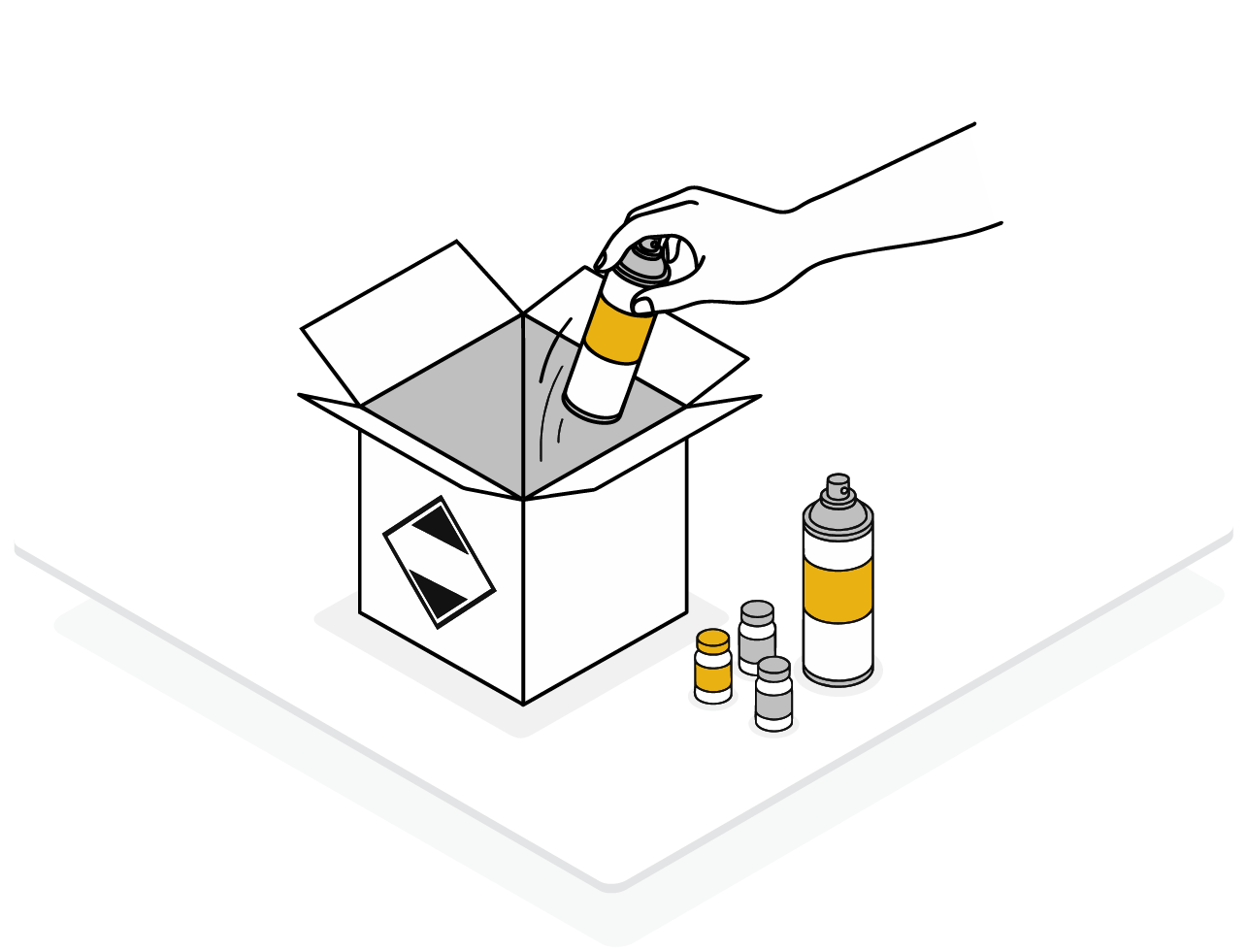
The limited quantity (LQ) exception lets you ship certain hazardous materials in small per-unit containers without United Nations (UN)-spec packaging, hazmat labels, shipping papers, or vehicle placards, as long as you meet the inner quantity limits, use strong outer packaging, mark each box with the LQ diamond, and stay under 30 kg gross mass per package (in most standard cases). The material remains regulated hazardous material under the Hazardous Materials Regulations (HMR).
Real-world example: 40 bottles of nail polish, 0.02 L each, packed in a cardboard box: total net hazmat 0.8 L, total gross weight ~1.5 kg. This qualifies as LQ under § 173.150(b) for Class 3 PG II. No hazmat label. No shipping paper. No placard. Just the LQ diamond mark.
Source: 49 CFR 172.101, 173.150 to 173.156, 172.315
Applicability
Is This Relevant to You?
The exception is designed for a specific shipping profile. Check both lists before you go further.
-
This applies to you if…
- You ship paints, aerosols, solvents, adhesives, cleaning products, cosmetics, or automotive fluids
- Your products come in small individual containers (under 1 to 5 L or 1 to 5 kg per unit depending on class)
- You ship primarily by truck or rail
- Your material is Packing Group II or III in the Hazardous Materials Table (HMT)
- Column 8A of the § 172.101 table references a Part 173 section for your UN number
- Your total package gross weight is under 30 kg (66 lbs) in most cases
-
This probably doesn’t apply if…
- You ship bulk quantities or large containers
- Your material is Class 1 (explosives)
- Your material is Class 7 (radioactive)
- Your material is Division 2.3 (toxic gases)
- Your material is Division 6.1 PG I, Hazard Zone A/B (poison-by-inhalation)
- Column 8A in the HMT is blank for your material
- You ship air-primary and your volumes exceed § 173.27(f) limits
Who benefits most
-
Consumer Goods & Brands
Paints, adhesives, aerosols, solvents, cleaning products, personal care. The classic LQ use case.
-
E-Commerce & FBA Sellers
Amazon FBA DG sellers shipping small-unit hazmat to fulfillment centers, within 30 kg gross per shipment.
-
Wholesale Distributors & DCs
Moving product from manufacturer to retailer. The regulation explicitly references this supply chain in § 173.156.
-
Cosmetics & Personal Care
Nail polish, hair spray, perfume, and other flammable or pressurized small-container products.
-
Hardware & Paint Retail
Small quantities of Class 3 or Class 8 materials in individual containers for retail distribution.
-
Retailers: Reverse Logistics
Returning damaged or unsold hazmat product to suppliers. A specific reduced-training provision applies here.
-
Specialty Chemical Companies
PG II/III materials in small inner containers where the HMT Column 8A authorizes LQ.
Before you proceed
One Thing to Keep in Mind
The limited quantity exception reduces your shipping requirements, but it does not eliminate all compliance obligations. Here is what may still be relevant regardless of how you ship.
What is an emergency response phone number?
A 24-hour emergency response telephone number is a line that first responders can call at any time during a hazmat incident to obtain safety information. Under DOT regulations (49 CFR 172.604), it is required on shipping papers whenever hazardous materials are transported. Under OSHA’s Hazard Communication Standard (29 CFR 1910.1200), it is also required in Section 1 of every Safety Data Sheet, separate from any shipping requirement.
Two distinct obligations: easy to confuse
-
DOT / shipping
Required on shipping papers when the LQ exception does not fully waive the documentation requirement (e.g. hazardous substances, wastes, marine pollutants, air or vessel transport).
-
OSHA / SDS
Required in Section 1 of the SDS if your company’s name appears on it as the responsible party. Applies to manufacturers, formulators, and private labelers, regardless of how or whether the product is shipped.
Why some LQ shippers still choose a provider like Hazmat Line
-
1
If any shipment inadvertently exceeds a limited quantity threshold, full DOT emergency response requirements apply immediately. Having a provider already in place means you are covered without scrambling.
-
2
If your company name is on an SDS, even for a product you consider low-hazard, OSHA requires a 24-hour emergency number in Section 1. This obligation exists independently of how you ship.
-
3
Hazmat Line provides year-round compliance guidance. If a requirement changes or a question comes up, you have a point of contact, not just a phone number.
-
4
If you need related services (SDS authoring, classification review, or training), Hazmat Line can help you identify the right provider.
Still in doubt about your ERI obligations?
Our team can help you confirm what applies to your specific shipments, no commitment required.
The value
What the Exception Actually Gets You
Ground transport is where the LQ exception delivers the most benefit. Here is what changes compared to a fully regulated shipment.
| Requirement | Fully Regulated Hazmat (Ground) | Limited Quantity Hazmat (Ground) |
|---|---|---|
| What changes | ||
| Outer packaging |
UN performance-tested specification packaging required |
Strong outer packaging (e.g. corrugated box): no UN spec required |
| Hazmat labels |
DOT hazard class labels required on each package |
No hazmat labels required: LQ diamond mark replaces them |
| Shipping papers |
Hazmat declaration required on bill of lading |
Not required in most ground cases |
| Vehicle placards |
Placards required on transport vehicle |
Not required |
| ERI number on shipping paper |
Required on shipping papers |
Not required (waived with shipping papers) |
| Package mark |
UN number, proper shipping name, PG, orientation arrows as applicable |
Square-on-point LQ diamond: that’s it |
| Carrier surcharges |
Hazmat surcharges typically apply |
Often avoidable: carriers may not treat as regulated hazmat |
| What does not change | ||
| Hazmat employee training |
Required |
Still required: not waived |
| Material classification |
Required |
Still required: not waived |
Need the number itself? From $599/yr, active within 24 hours.
Get startedEligibility & quantity limits
Does Your Material Qualify?
-
1
Look up your material in the § 172.101 HMT
Find your UN number or proper shipping name. Check Column 8A. If it shows a reference to a Part 173 section (e.g. “173.150”), LQ may be available. If Column 8A is blank, no LQ exception exists for that entry.
-
2
Check the inner packaging quantity limit in Part 173
The referenced Part 173 section defines exactly how much hazmat is allowed per inner container. Every inner packaging in the box must stay at or below this limit.
-
3
Check the 30 kg gross mass limit
Most standard LQ combination packages are limited to 30 kg (66 lbs) gross mass per package. Palletized units under § 173.156 and manufacturer-to-retailer highway shipments have exceptions. If your package exceeds 30 kg with no applicable exception, full DOT requirements apply immediately.
-
4
Use the right outer packaging
Most LQ shipments use combination packagings: an inner container inside a strong outer box. UN-spec certification is not required. The outer must be structurally sound and meet general packaging integrity requirements under Subpart B of Part 173.
Inner packaging limits by hazard class
| Hazard class | Inner packaging limit | CFR section |
|---|---|---|
| Class 3: Flammable liquids (PG II) |
1 L per inner |
§ 173.150(b) |
| Class 3: Flammable liquids (PG III) |
5 L per inner |
§ 173.150(b) |
| Class 8: Corrosives (PG II) |
1 L or 1 kg per inner |
§ 173.154(b) |
| Class 8: Corrosives (PG III) |
5 L or 5 kg per inner |
§ 173.154(b) |
| Division 4.1: Flammable solids (PG II/III) |
500 g per inner |
§ 173.151(b) |
| Division 4.3: Dangerous when wet (PG II/III) |
500 g / 0.5 L per inner |
§ 173.151(d) |
| Division 5.1: Oxidizers (PG II/III) |
500 g / 0.5 L per inner |
§ 173.152(b) |
| Division 6.1: Toxic (PG II/III, non-PIH only) |
500 g / 0.5 L per inner |
§ 173.153(b) |
| Class 2: Aerosols |
1 L per inner |
§ 173.306(a) |
| Class 9 / Miscellaneous |
Varies by HMT entry |
§ 173.155(b) |
Palletized Unit Exception (§ 173.156)
When inner packagings are placed into fiberboard trays, then into a fiberboard box banded to a pallet, the 30 kg per-package limit is replaced by a maximum of 250 kg (550 lbs) net hazmat per palletized unit.
Not sure if your product qualifies?
Our team can review your material, check the Hazardous Materials Table, and confirm whether the Limited Quantity exception applies.
Class-specific detail
Requirements by Hazard Class
Once you’ve confirmed eligibility, the class-specific sections of Part 173 define your exact requirements. Here are the nuances for the most common LQ classes.
-
§ 173.150
Class 3: Flammable Liquids
The most common LQ class. PG II limit: 1 L per inner. PG III limit: 5 L per inner. Covers paints, nail polish, solvents, adhesives, most flammable cleaning products. Retail ethyl alcohol products have a specific provision under § 173.150(g). Air limits are significantly tighter.
-
§ 173.154
Class 8: Corrosives
PG II: 1 L or 1 kg per inner. PG III: 5 L or 5 kg per inner. Covers battery acid, drain cleaners, certain rust removers. Reverse logistics provisions apply under § 173.157 for highway returns of damaged product.
-
§ 173.306
Class 2: Aerosols
1 L per inner container. Covers hair spray, deodorant, spray paint, WD-40, and similar pressurized consumer products. The aerosol exception is one of the most-used LQ pathways in e-commerce and retail distribution.
-
§ 173.153
Division 6.1: Toxic Materials
PG II/III only: the PIH exception does not apply. 500 g or 0.5 L per inner. Covers certain pesticides, industrial chemicals, and disinfectants. PIH materials have no LQ pathway and face more stringent requirements across all modes.
Mode-specific requirements
Marking Requirements & Transport by Mode
The square-on-point mark is required on every LQ package. What else is required depends on how you’re shipping.
-
GROUND & VESSEL
No “Y” symbol
Min 100 mm per side · ≥ 2 mm border
At least one side or end of outer packaging
-
AIR TRANSPORT
“Y” symbol required
Same dimensions · One side only
Stricter quantity limits apply (§ 173.27(f))
-
GROUND / HIGHWAY
Where the full benefit of LQ applies.
No hazmat labels, no shipping papers, no placards, no UN-spec packaging. Only the square-on-point mark on at least one side or end of the outer packaging.
Exception: if your material is also a hazardous substance, hazardous waste, or marine pollutant, shipping papers reinstate. The private motor carrier highway exception (§ 172.315(a)(3)) allows skipping the mark for PG II/III materials when five strict quantity conditions are met, but requires a 24-hour ERI number on each package instead.
-
AIR
LQ still provides some savings on air, but considerably less than ground.
The Y-mark is required. Shipping papers and hazmat labels reinstate. Quantity limits per inner packaging are stricter, governed by § 173.27(f) and IATA DGR.
The Y-mark may also be used as a universal alternative for ground shipments where quantities meet the stricter air limits, useful for multi-modal shippers who want one mark on all packaging.
-
VESSEL
LQ is permitted by vessel, but shipping papers reinstate.
The square-on-point mark is required. For cargo transport units (CTUs), the mark must appear on each side and end at a minimum 250 mm per side.
The primary benefit retained for vessel: no UN-spec packaging required. Placarding is still generally waived for individual packages. Check IMDG Code provisions for international waters.
Emergency response number: by scenario
| Transport scenario | Shipping paper ERI required? | Package ERI required? |
|---|---|---|
| Standard LQ ground, with square-on-point mark |
No: waived with shipping papers |
No |
| Private motor carrier highway exception (no mark used) |
No |
Yes: on each package |
| Air transport (Y mark) |
Yes: shipping papers required |
Yes |
| Vessel transport |
Yes: shipping papers required |
No |
| LQ material that is also a hazardous substance, waste, or marine pollutant |
Yes: shipping papers required |
No |
-
What counts as a valid ERI number (§ 172.604)
The number must be monitored at all times the hazardous material is in transportation. It must connect immediately to a person knowledgeable about the material, or to a third-party ERI service provider. It cannot be voicemail, an answering service, or a business-hours line.
- Many shippers use third-party ERI service providers under § 172.604(c)(2)
- Must be monitored including nights, weekends, and holidays
- For domestic US shipments, include area code; for international origination, include international access code
-
An unanswered ERI number is a regulatory violation
In a hazmat incident, first responders call the ERI number for immediate chemical guidance. If no one answers or the number is incorrect, that is a violation of § 172.604 and a direct public safety failure. PHMSA civil penalties can reach tens of thousands of dollars per incident.
Always required
Hazmat Training: Not Waived
Limited quantity status does not waive the hazmat training requirement under Subpart H of Part 172.
-
Who must be trained
Any “hazmat employee”: anyone who prepares hazmat for transport, operates a vehicle carrying hazmat, or performs a function regulated under HMR. Includes warehouse staff who apply marks or prepare packages.
-
Recurrence & records
Training must be refreshed at least every 3 years. Employers must maintain records of each trained employee’s name, completion date, and materials covered, during employment and for 90 days after.
Reference
Full Regulatory Reference Map
Every CFR section relevant to limited quantity compliance, in one place.
| What it covers | CFR section |
|---|---|
| Which materials qualify for LQ: HMT |
§ 172.101, Col. 8A |
| Quantity limits: Class 3 (flammable liquids) |
§ 173.150(b) |
| Quantity limits: Division 4.1/4.3 |
§ 173.151(b)(d) |
| Quantity limits: Division 5.1/5.2 |
§ 173.152(b) |
| Quantity limits: Division 6.1 (toxic, non-PIH) |
§ 173.153(b) |
| Quantity limits: Class 8 (corrosives) |
§ 173.154(b) |
| Quantity limits: Class 9 / miscellaneous |
§ 173.155(b) |
| Quantity limits: Class 2 aerosols |
§ 173.306(a) |
| General LQ exceptions, palletized units, display packs |
§ 173.156 |
| Square-on-point mark requirements |
§ 172.315 |
| Shipping paper requirements |
§ 172.200 to 172.205 |
| Placard requirements and LQ exemption |
§ 172.500, Subpart F |
| Emergency response telephone number |
§ 172.604 |
| Hazmat training requirements |
§ 172.700, Subpart H |
| Air transport quantity limits |
§ 173.27(f) |
| Waste LQ exceptions |
§ 173.12(h) |
| Reverse logistics (LQ returns) |
§ 173.157 |
| OSHA SDS emergency number requirement |
29 CFR 1910.1200 |
Frequently asked questions
Common Questions About Limited Quantity Hazmat
Is limited quantity considered hazmat?
Yes. The limited quantity designation is a reduced-requirement exception, not a classification change. The material remains regulated hazardous material under the HMR. Shippers remain responsible for correct classification, proper marking, and applicable compliance obligations.
What does limited quantity hazmat mean?
A hazardous material packaged in a small enough per-unit quantity to qualify for reduced DOT marking, labeling, and shipping paper requirements under 49 CFR Part 173. The exception applies per unit, not to the total shipment. The material remains regulated hazmat and the shipper remains responsible for correct classification, training, and (in some scenarios) an emergency response number.
Does limited quantity hazmat require placards?
Generally no. Packages bearing the square-on-point mark are exempt from standard DOT placard requirements under Subpart F of Part 172. The exception does not apply if the package also contains a hazardous substance, hazardous waste, or marine pollutant. Class 1, Class 7, Division 2.3, and Division 6.1 PG I materials are excluded from the LQ exception entirely.
Is nail polish a limited quantity item?
Yes. Consumer nail polish is typically classified as a flammable liquid (UN 1263, Class 3, PG II or III) and commonly qualifies under limited quantity provisions when inner container volumes and aggregate limits are met. For PG II, the inner packaging limit is 1 L; for PG III, 5 L. Verify against § 173.150(b) and confirm your HMT entry authorizes the LQ exception in Column 8A.
Do limited quantity shipments need an emergency response number?
For standard LQ ground shipments with the square-on-point mark, the § 172.604 ERI number is waived along with shipping papers. However, air and vessel transport reinstate shipping paper requirements including an ERI number. Separately, if your company name appears on a Safety Data Sheet as the responsible party, OSHA (29 CFR 1910.1200) requires a 24-hour emergency number in Section 1 of that SDS, a separate obligation from DOT shipping requirements.
What if one shipment accidentally exceeds the LQ limit?
If a shipment exceeds the limited quantity thresholds, either the per-inner-packaging limit or the 30 kg gross mass limit, the full DOT hazardous materials regulations apply immediately for that shipment. That means UN-spec packaging, hazmat labels, shipping papers, placards, and an ERI number. Having an ERI provider already in place means you are covered without scrambling if this happens.
Do I need an ERI number on my SDS?
Yes, if your company name appears on the Safety Data Sheet as manufacturer, formulator, or private labeler. OSHA's Hazard Communication Standard (29 CFR 1910.1200) requires a 24-hour emergency telephone number in Section 1 of every SDS. This obligation exists independently of DOT shipping requirements and is not waived by the limited quantity exception.
Keep reading
-
Compliance guide
DOT 49 CFR Part 172
What Part 172 requires on shipping papers and how to meet the 24-hour emergency number rule.
Read more → -
Solution
Battery shippers
24/7 emergency response coverage for lithium battery shipments.
Read more → -
Solution
Amazon FBA
The 24/7 emergency number for dangerous goods sold through Amazon FBA.
Read more →
Still have questions about limited quantity compliance?
Our team can help you confirm eligibility, understand your ERI obligations, and get set up with a DOT-compliant emergency response number if you need one.
No commitment · Response within 24 hours